martes, 12 de marzo de 2024

7.Plastics

                                                               Plastics    


Many objects we use every day are made of plastic. Plastics are made of carbon and hydrogen. Thesee chains of macromolecules called polymers, which is another name for plastics. Polymers are composed pf smaller molecules called monomers.

Plastics can be divided into two general types according to their origin:

       -Natural Plastics: obtained directly from vegetables or animal sources. For example, latex and cellulose are produced by plants, and casein is a protein that is found in milk.

   -Synthetic plastics: Come from oil, Most plastics that we use today are synthetic.

Properties:

   1. Good insulator

   2. Combustible

   3. Ductiles and malleable

   4.High mechanical strength

   5. Great elasticity

   6. Flexible and light

   7. Great plasticity

   8. Most of them are recyclebles

   9. Resistant to corrosion

   10. They are very economic

Types of plastics

   Thermoplastics: you can heat them and mould them as many times as you want. Easy to recycle.

   Thermosettings: con only be heated and moulded once and the process cannot be repeated.

   Elastomers: they stretch a lot when applaying forces and can recover their original shape after suffering huge deformations.

Enviroment problems

  1- Crude oil is a finite resource, it’s going to run out one day.

  2- The process of turning crude oil into plastics uses a lot of energy.

  3- Most plastics are not biodegradable and are disposed in landfill sites, at best. They’re buried and take

hundreds of years to degrade. The decomposition of plastics pollutes and poisons the earth.

Plastic Manufacturing

    1-Injction: melted plastic is introduced into a mould. When the material cools down, it is remove. We can do Household conteiners, buckets...

   2-Extrusion: A rotation screw makes the plastic go through a hole. Once the plastic cools

down, we obtain long pieces of materials that can be cut. we can do tubes, water pipes...

   3-Blow: The material that is produce by extrusion, is introduced in a mould. Then the mould is filled with air and the plastic takes the shape of the mould. We do the bottles or some toys.

  4- Compresion: It is very useful for big simple thermosetting pieces like trays anf¡d containers. The plastic is shaped by the moulds on both sides.

   5- Vacuum: A sheet of thermoplastic is heated until it becomes soft ans then the air under the sheet is sucked out to create a vacuum. 


                                              Thermoplastics  

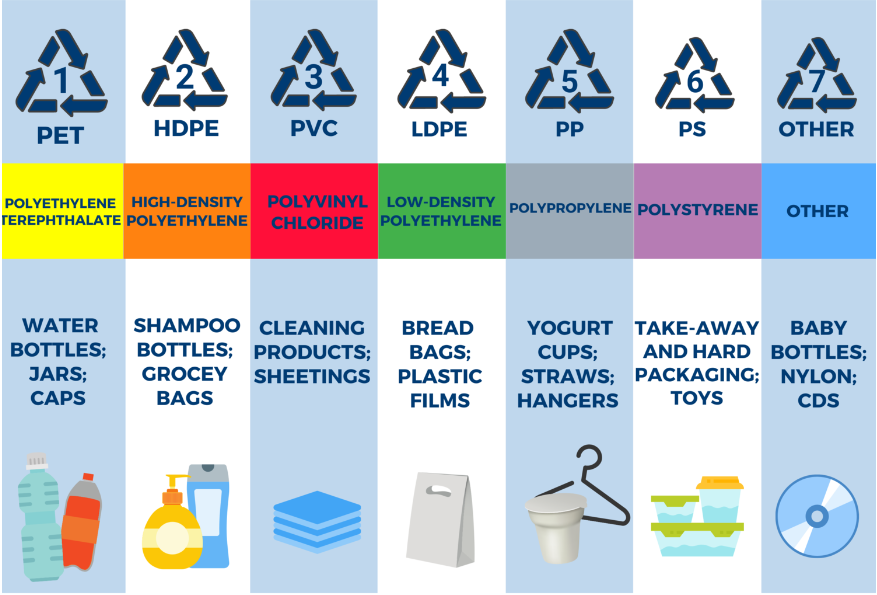
     There are 7 big types of thermoplastics 

1.-PET (polyethylene terephthalate)

It's a lightweight, recyclable plastic that is resist and to wear and tear. Has high transparency, it does not emit toxic substances, so it's suitable for holding food.
It is use to make bottles. It's also recyclable and can used to produce textile fibres to make clothes.

2.-HDPE (high-density polyethylene)
Is is opaque, inflexible and resistant to chemicals. It's non-toxic, so it's suitable for holding food.
 It is used for milk bottles, some bags, pipes and containers, among other objects.
3.- PVC (polyvinyl chloride)
Highly resistant to abrasion and impact.
It is used in pipes, cable insulation and profiles for doors and windows.


4.- LDP (low-density polyethylene)
It is soft and easily scratched. It is mainly used to make bags and packaging film.


5.- PP (polypropylene)
A plastic that is easy to model and dye. It is resistant to solvents and splintering.
It is used to make toys, folders, packing, healthcare equipment and house hold items.


6.- PS (polystyrene)
It is a very lightweight plastic that breaks easily. It is used to make packing for dairy products, stationery and toys.
Expanded polystyrene (Styrofoam) is widely used for packing, food packaging, food packaging and thermal insulation.

7.- Others
This is for other plastics that are mixtures of different resins, such as nylon, polycarbonate, or ABS (used in 3D printing).


The plastic materials in groups 1,2,4 and 5 are easily recyclable. Those in groups 3 and 6 can be recycled at specialized facilities. Those in group 7 are very difficult or imposible to recycle, depending on the resins used in them.


jueves, 29 de febrero de 2024

7.Materials

                              Materials 

            Today we had to do a little scheme about types of wood and metals, of wich we specified what                    types what was in in each material.

                        Click there to see my scheme!⟶ ☆

viernes, 26 de enero de 2024

6. Graphic expresion and comunication


    We strated this pulled apart doing some cordinate exercises, absolute, relative and polar, then we download Qcad and we strated to use it. We have done the same exercises but now in Qcad

                      Click here to see my Qcad exercises ➡ :))

martes, 5 de diciembre de 2023

5.Mechanisms

✿⬅Click There


  In this infrogram what we did was to divide the types of mechenisms and each one made  

              one, it was my turn to make the linear tranmission.


       After we do that infrogram we started to study some equitions to do problems with mechanisms

           The equition for problems with levers:

                     F1*d1 =F2*d2 F=force or weight; d=distance to the fulcrum

            The equition for problems with pulleys and belts:

                        N1*d1=N2*d2  N=rotary velocity (rpm); d=diameter

           The equition for problems with gears:

                      N1*z1 = N2*z2 N=rotary velocity (rpm); z=number of cogs 


4.structures


                            In this task we had to do a macarroni structure by couples. I was doing 

                            it with ama we dont have a photo of the structure finished, but we have a 

                            photo of a little detail we have done on our proyect.


3.technology, society and enviroment


                             In this report what we had to do was to explain ehat was teh impact of                                                      technology on the enviroment. For example, What is the technological

                            gap or the digital divide? Here you have the answer


                                                        ★← Click there!!


2.Budget


In this job, what we did was a budget for the tools we have in the workshop 
                                 

                          Here is a link to see mi exel ➡ <3

Procesing

 Procesing Processing is an open-source programming language and integrated development environment based on Java, used as a medium for teac...